

THE CAVALIER KING CHARLES SPANIEL
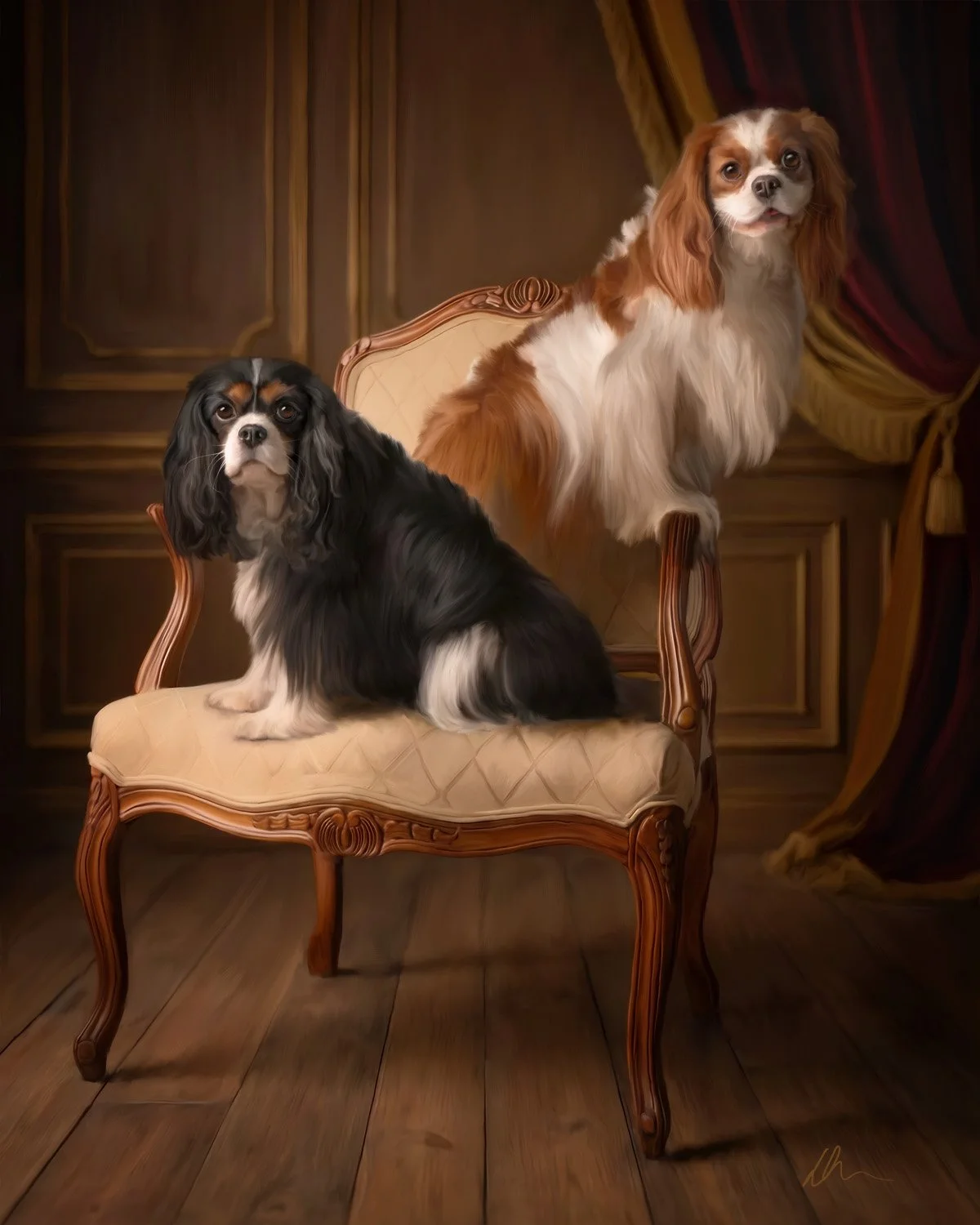
The Cavalier King Charles Spaniel is a bit unusual: a living reconstruction inspired by art.
Small spaniels appear in European paintings as far back as the 16th century. They became closely associated with the English court under Charles I and Charles II, who were rarely seen without several at their heels. These dogs had longer muzzles and flatter skulls than the King Charles Spaniels we know today. They were small companion dogs, but they still had the build and instincts of sporting spaniels.
By the mid-1800s, English breeders began favoring dogs with domed heads, shorter noses, and more prominent eyes. Over time, the longer-faced spaniel seen in paintings by Van Dyck and other Old Masters nearly disappeared. The shorter-faced breed remained the King Charles Spaniel in Britain and became known as the English Toy Spaniel in the United States.
Then, in 1926, an American named Roswell Eldridge attended Crufts and was disappointed to find that the spaniels looked nothing like those depicted in portraits from the time of Charles II. He offered £25 each for the best male and female “Blenheim Spaniel of the old type,” specifying a long face, a flat skull, and a spot in the center of the head.
English breeders were not particularly interested. They had spent generations breeding away from the long nose Eldridge wanted them to restore. Only a few accepted his challenge.
In 1928, a dog named Ann’s Son won the prize. He was considered close enough to the old type that breeders placed him on a table during their first club meeting and used him as the living model for the new breed standard. They also brought reproductions of spaniels from 16th-, 17th-, and 18th-century paintings to guide them.
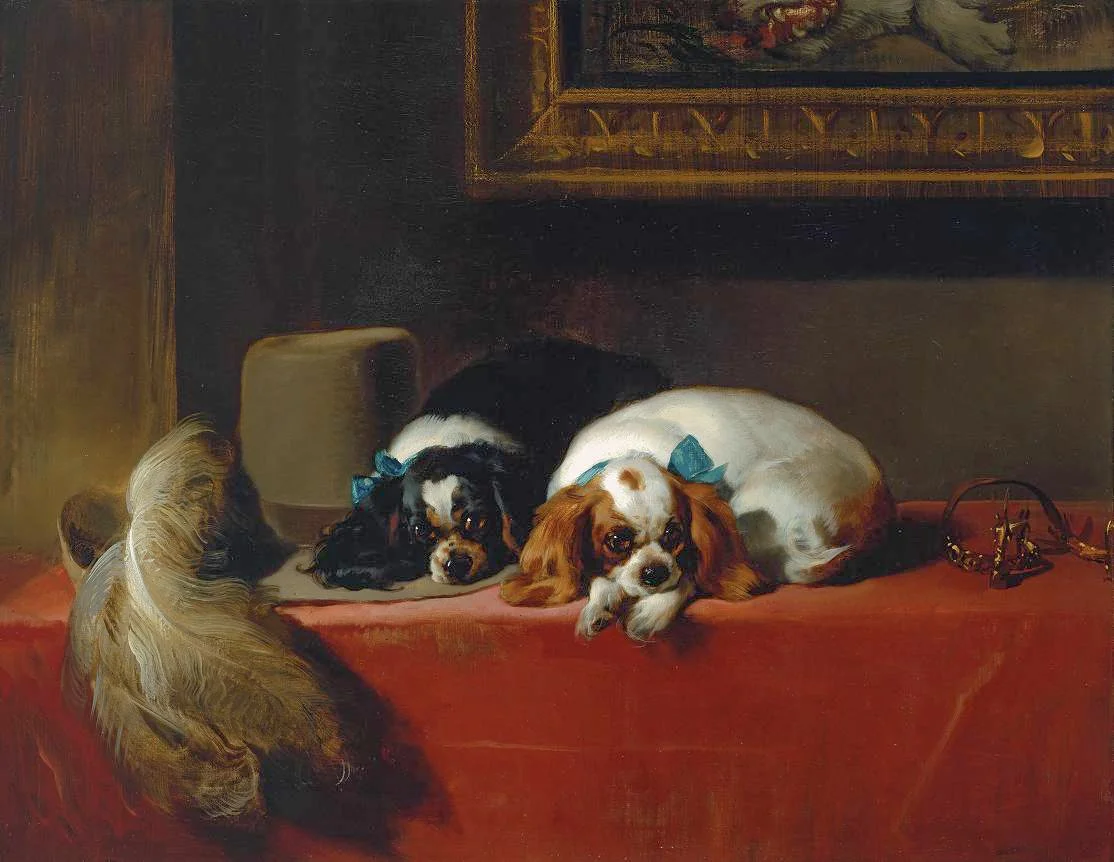
“The Cavalier’s Pets” by Sir Edwin Landseer
The name Cavalier King Charles Spaniel was chosen to distinguish the reconstructed dog from the shorter-faced King Charles Spaniel. “Cavalier” was also connected to the Royalist supporters of Charles I, as well as Sir Edwin Landseer’s painting The Cavalier’s Pets, which helped shape the breeders’ vision for the revived spaniel.
Roswell Eldridge died before he could see what his challenge had started.
The young breed nearly disappeared again during World War II. Food shortages made keeping large kennels almost impossible. The influential Ttiweh kennel went from approximately 60 Cavaliers to only three, and just 60 dogs were registered in Britain between 1940 and 1945.
Enough survived to continue the breed. In 1945, the Kennel Club granted the Cavalier separate registration from the King Charles Spaniel.
The Cavalier’s American history began in earnest in 1952, when Sally Lyons Brown of Kentucky received a puppy from England. Because the breed was not recognized by the American Kennel Club, she helped establish an independent registry and breed club instead. The Cavalier King Charles Spaniel Club, USA, was incorporated in 1956 and still operates today.
The AKC approved the Cavalier in 1995, with full recognition taking effect on January 1, 1996.
The King Charles Spaniel and the Cavalier King Charles Spaniel are recognized as two separate breeds in Britain. In the United States, they are the English Toy Spaniel and the Cavalier King Charles Spaniel.
The Blenheim spot
Cavaliers come in four recognized colors: Blenheim, tricolor, black and tan, and ruby.
Blenheim is the familiar chestnut-and-white pattern. Its name comes from Blenheim Palace, where the Dukes of Marlborough kept red-and-white spaniels in the early 1700s. These dogs were valued both as companions and as small sporting spaniels.
Some Blenheim Cavaliers have a chestnut mark in the center of the forehead, known as the Blenheim spot or Duchess Thumb Print.
According to legend, Sarah Churchill, Duchess of Marlborough, was waiting for news of her husband during the Battle of Blenheim. As she waited, she pressed her thumb against the head of a pregnant spaniel. When the puppies were born, each carried a chestnut mark where her thumb had rested.
The modern Cavalier is a 20th-century attempt to recover an older kind of spaniel, using paintings, surviving throwbacks, and one art lover's dissatisfaction with what he found at Crufts.
For the painting, I wanted to put them in the same type of environment as the older paintings that inspired Roswell Eldridge.
Prints of the Cavalier painting are available in the 205 Project shop at pouka.com/full-shop/205-project.
If you'd like to commission a portrait of your own dog, you can find information about the process at pouka.com/commissions.