
THE FLAT-COATED RETRIEVER

Ask anyone who has spent time with a Flat-Coated Retriever and the same words come up. Happy. Mischievous. Irrepressible. This is a breed that approaches life with genuine enthusiasm and, frankly, a sense of humor. They are eager to please but not above going for a laugh if the opportunity presents itself. The tail is perpetually in motion and the optimism never wavers.
The breed was developed in the early 1800s from a mix of Labrador Retrievers, Newfoundlands, and Setters. A touch of Collie gave them their distinctive long, clean head shape — one of the breed's most recognizable features. The name "Retriever" was never just a label. It described a job, and the Flat-Coat was built to do it well.
Early litters regularly produced yellow and brown dogs alongside the dominant black. Those yellow dogs eventually found their own path, developing into what we now know as the Golden Retriever. The liver color still appears today and is fully accepted by AKC standards, though black remains the breed's signature.
The Flat-Coat's survival is not something to take for granted. The breed came dangerously close to disappearing entirely after World War II, and the dogs alive today trace back to only a handful of surviving lines. That recovery effort produced something remarkable — a dog with an almost uncommon depth of working drive paired with a personality that is impossible not to love.
Paddy Petch, author of The Complete Flat-Coated Retriever, is credited with calling them the Peter Pan of dogs, and it fits precisely. They mature more slowly than other breeds and maintain their puppylike exuberance well into their years — not as a flaw, but as a feature. The Flat-Coated Retriever Club of America works deliberately to keep the breed dual-purpose, believing — correctly, I think — that the personality is inseparable from the working instinct.
For this painting, I chose an autumn marsh setting to set off that stunning black coat against the warm golds and rusts of the season. The standing pose was intentional — it lets the breed's build and distinctive head structure speak clearly. Look closely and you'll find a pheasant tucked into the background.
Own a Flat-Coated Retriever? Learn about commissioning a portrait.
This painting is available as a fine art print in the shop. View print options.
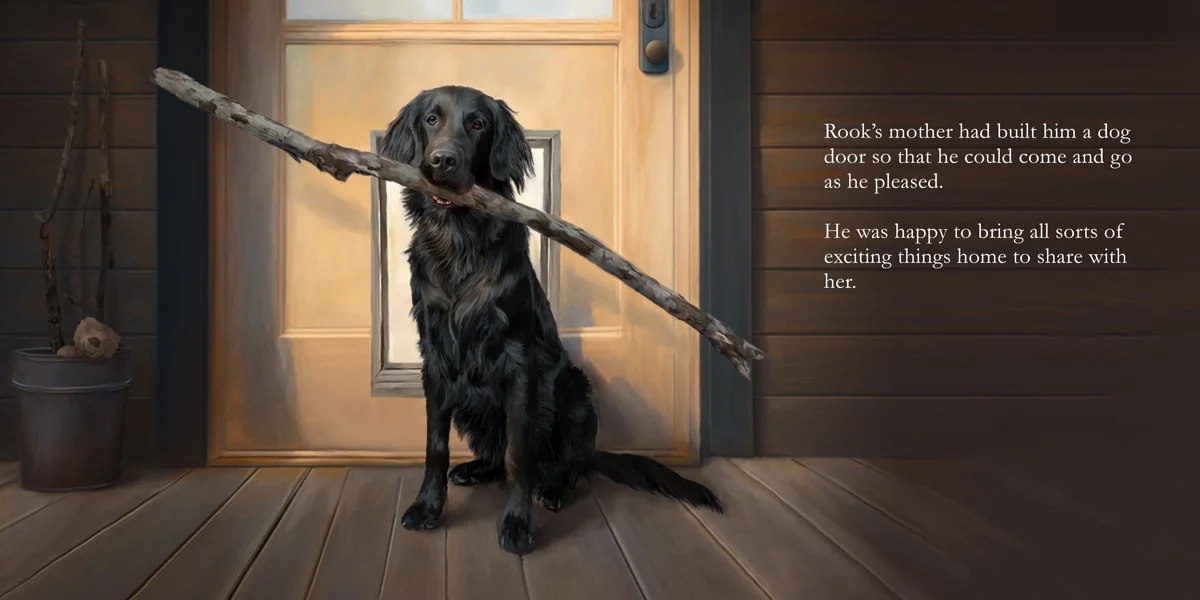
Rook is my Fletter, a Flat-Coated Retriever and English Setter mix, and the inspiration behind my children's book. The FCR side of him is unmistakable — the joy, the love of showing off whatever toy he happens to have found, and the tail that never quite stops waving.