

THE POMERANIAN
A Royal History: How the Pomeranian Became a Favorite
The Pomeranian may be one of the smallest dogs in the toy group today, but its roots are much larger—literally.
The breed takes its name from Pomerania, a region along the Baltic Sea that is now part of Germany and Poland. The early dogs from this area were part of the spitz family, the same general group that includes breeds like Samoyeds and Norwegian Elkhounds. These were sturdy northern working dogs, often weighing 20 to 30 pounds, and they were used for tasks like herding livestock and pulling small sleds.
Over time, smaller versions of these spitz dogs began to appear. By the 18th century, the developing breed had already found its way into European households. But the Pomeranian’s rise in popularity is closely tied to one famous admirer.
Queen Victoria of England discovered the breed while traveling in Italy in the late 1800s. She brought several Pomeranians back to Britain and became an enthusiastic breeder and exhibitor. Her dogs were noticeably smaller than many of the others at the time, and their popularity quickly set a new direction for the breed. As breeders followed her lead, the size gradually decreased until the compact, fox-faced Pomeranian we recognize today became the standard.
By the time Pomeranians began appearing in early dog shows, they had already made the transition from working dogs to companion animals. Their bright expression, luxurious double coat, and confident personality made them stand out immediately.
Despite their tiny size today, Pomeranians still carry the spirit of their larger spitz ancestors. Spend a little time with one and it becomes obvious.
They may be small, but they certainly don’t realize it.
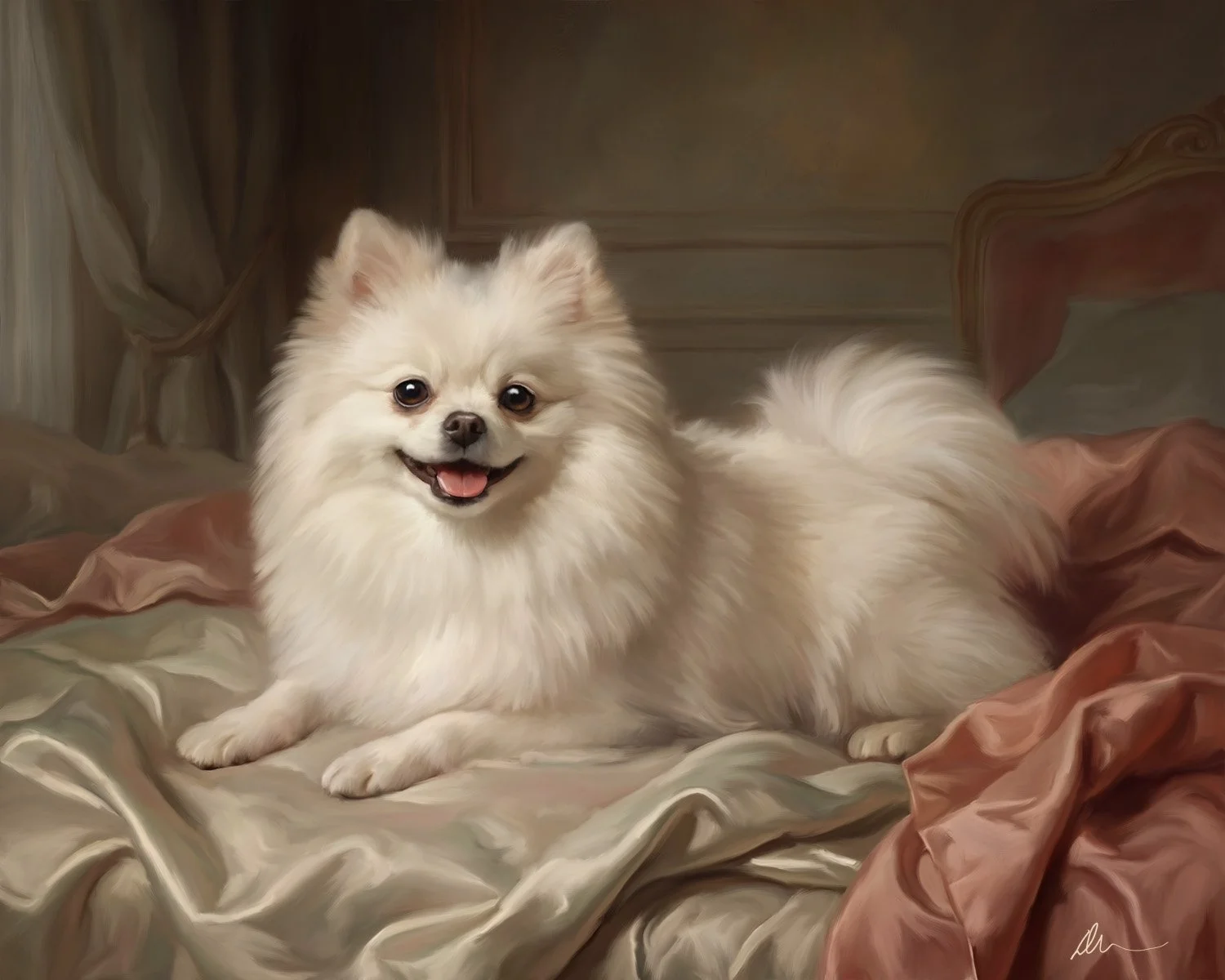
As portrait subjects, Pomeranians present a particular and delightful challenge. The coat is the obvious starting point — that dense double layer with its distinctive ruff around the neck and shoulders creates a halo effect that catches light beautifully. Getting the texture right, the way individual strands catch the light differently than the underlying layer, is one of the more satisfying technical puzzles in painting this breed.
But the coat is almost secondary to the expression. Pomeranians have an alertness to their face — bright, dark eyes set against that fox-like muzzle — that communicates personality immediately. They are not passive sitters. Even in stillness there is something watchful and slightly imperious about them, as though they are tolerating your presence rather than enjoying it. That quality translates remarkably well into a formal painted setting. They wear it naturally.
The breed also tends to attract owners with a specific sensibility — people who appreciate a dog with opinions, who find the mismatch between tiny body and enormous confidence genuinely endearing rather than exhausting. Those owners tend to understand instinctively why a royal setting suits their dog. The painting doesn't feel like a joke to them. It feels like an accurate character study.
If you have a Pomeranian you'd like painted — whether they're still stealing the spotlight at home or living on only in your photographs — I'd love to hear about them.
In this painting, the tiny white Pomeranian is resting comfortably on silk sheets in a formal royal bedroom. The setting reflects that long royal connection and the natural self-assurance the breed is known for. It felt like the right environment for a dog that seems perfectly at ease in such surroundings.