
The ridge is the first thing anyone notices. That distinctive stripe of backward-growing hair running along the spine is so dominant a gene that it survived every cross, every generation, and every attempt by European breeders to impose their own preferences on the emerging breed. It comes from the Khoikhoi dog, the indigenous hunting dog of the African Cape Peninsula, and it has been there for a very long time.
The Khoikhoi dog is one of Africa's oldest canine lineages, descended from ancient Egyptian dogs that spread southward through the continent over thousands of years, adapting entirely through natural selection to the demands of the African landscape. By the time Dutch settlers arrived at the Cape in the mid-1600s, these dogs had been shaped by Africa for centuries. They were lean, hard, fearless, and in the eyes of the Europeans who first encountered them, not particularly attractive. What the Europeans couldn't ignore was what the dogs could do.
The Dutch needed dogs suited to conditions their own breeds simply couldn't handle. The heat, the terrain, the predators, the sheer scale of the southern African bush were nothing like anything a European hunting dog had been bred for. The Khoikhoi dog could handle all of it. So they began crossing their own imports - Greyhounds, Bloodhounds, Great Danes, various terriers - with the indigenous dogs. Breeds came and went from the mix. The ridge kept coming back. Generation after generation, no matter what European blood was introduced, that backward stripe reasserted itself. Genetic analysis of the modern Ridgeback shows only around 4% pre-colonial African ancestry, but that 4% carried the ridge.
The breed took its definitive shape in Matabeleland, in what was then called Rhodesia and is now Zimbabwe, in the late 1800s. A big-game hunter named Cornelius van Rooyen spent the better part of 35 years refining his pack for a very specific job. The goal wasn't to produce a dog that would kill lions. No dog can kill a lion. The goal was to produce a dog that could hold one's attention long enough for the hunter to get into position for a clean shot, with primitive rifles, at close range, on an animal that could end the hunt in a single swipe. The dogs worked in pairs or small groups, darting in and out, snapping and retreating, keeping the lion focused and disoriented. It was a job that required speed, agility, intelligence, and the specific kind of courage that knows when to push and when to get out of the way. Dogs that misjudged it didn't survive to pass their qualities on. Natural selection finished what van Rooyen started.
Beyond lions, the Ridgeback was a working farm dog in every sense. They cleared land of baboons and warthogs, guarded livestock and homesteads, and proved themselves against leopards, which in dense bush are considerably more dangerous than lions on open ground. They were an all-purpose answer to the demands of life on the African frontier.
The breed was formalized in 1922 in Bulawayo by F.R. Barnes, who drew up the first standard, borrowing curiously from the Dalmatian standard of all things. It changed very little from that day to this. The name was changed from African Lion Dog to Rhodesian Ridgeback, on the logic that while any dog might theoretically hunt a lion, not every dog carries that ridge. The country of Rhodesia became Zimbabwe in 1980, but the breed's name stayed put. The ridge made them distinct, and they kept the name of the country where it all started.
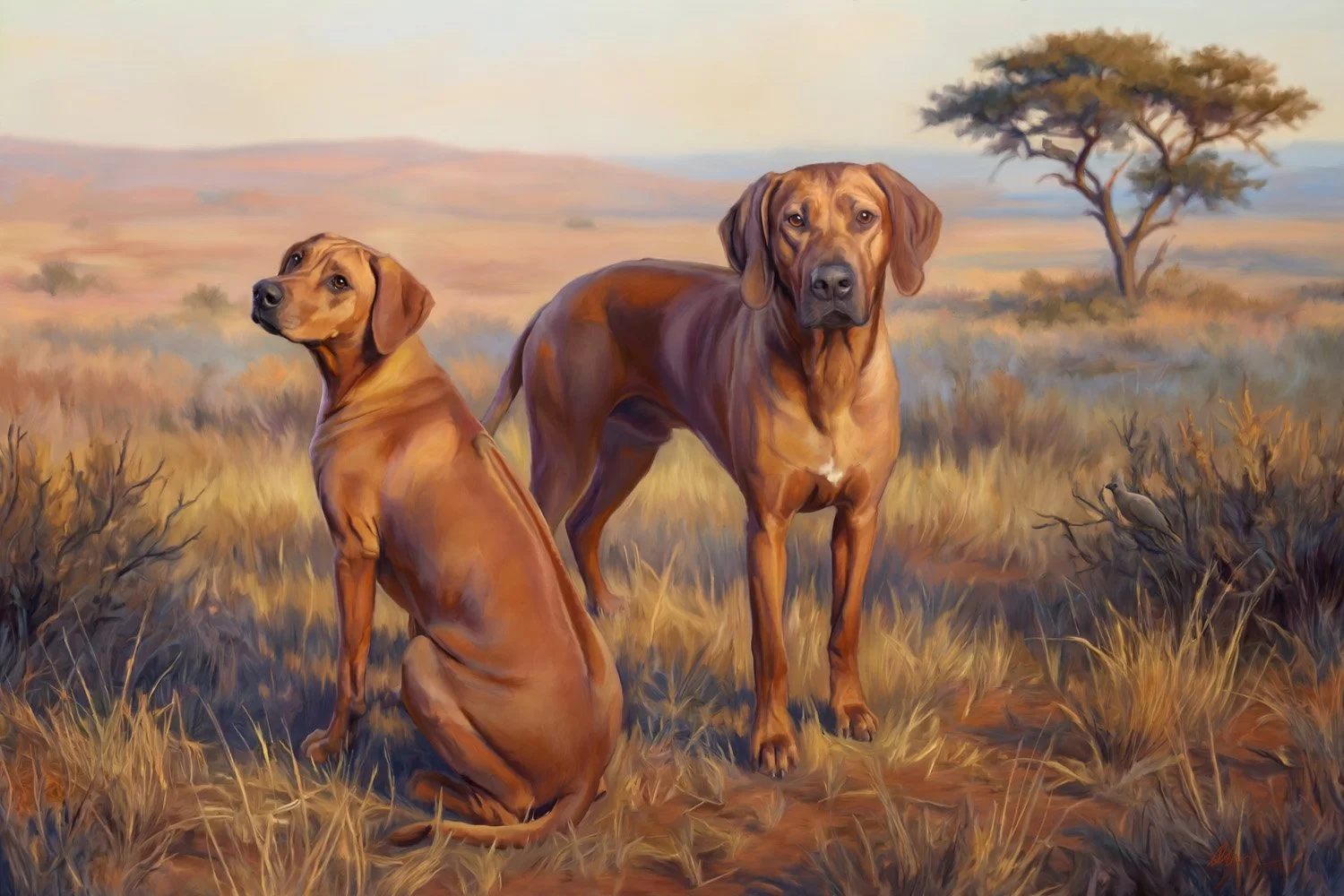
For this painting I placed Roxie and Hank in the Zimbabwe landscape their breed was built for — ochre earth, dry golden grass, and a wide open sky. Hank, the older male, stands at the center while young Roxie sits alert beside him. A leopard rests in the branches of a camel thorn acacia in the background, and if you look carefully at the shrub on the right, you'll find a grey go-away bird keeping watch.
This painting is available as a fine art print in the shop. View print options.
If your breed is finished and you'd like a custom portrait of your own dog, the commission process starts here.
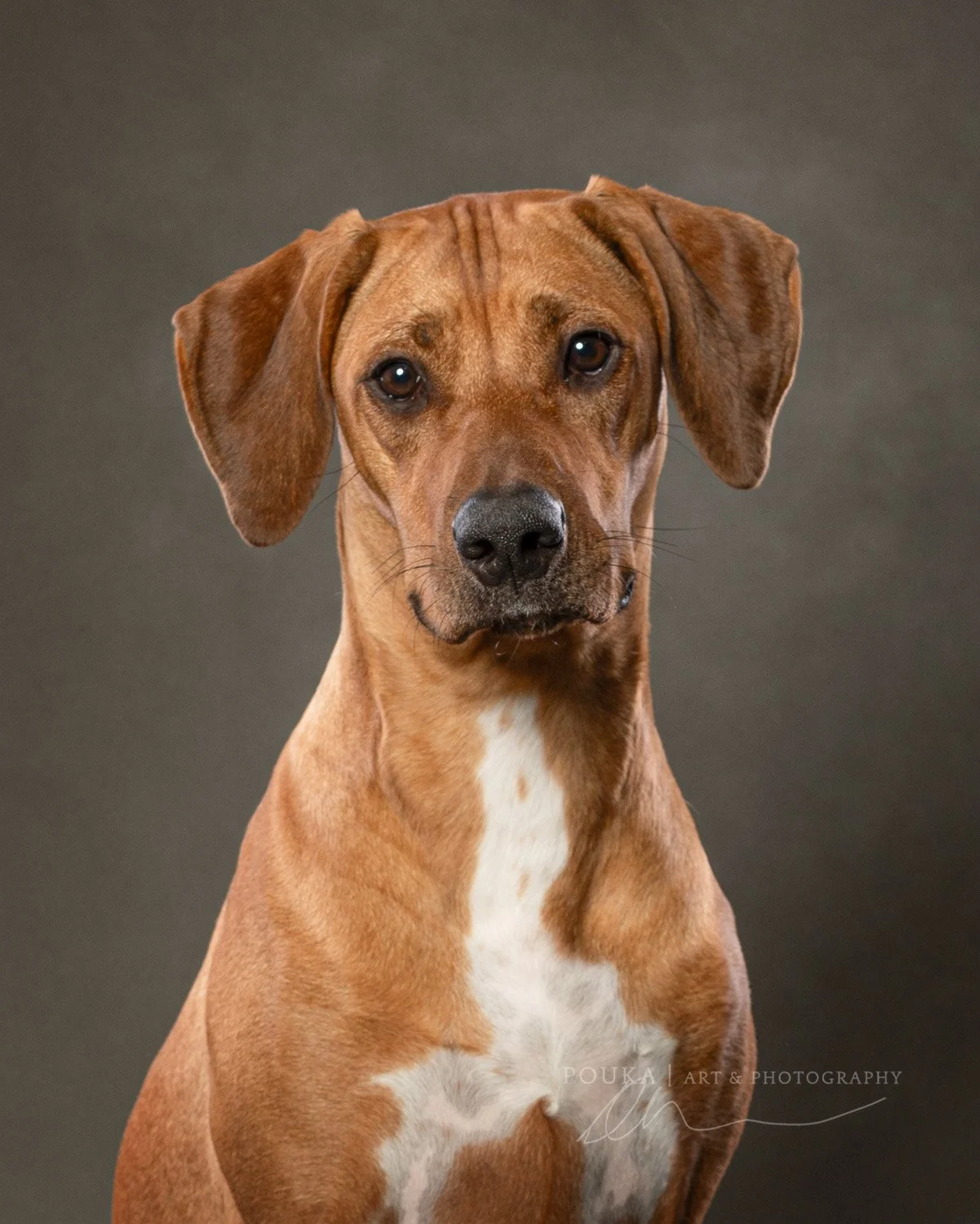
Evolution’s The Power “Roxie”
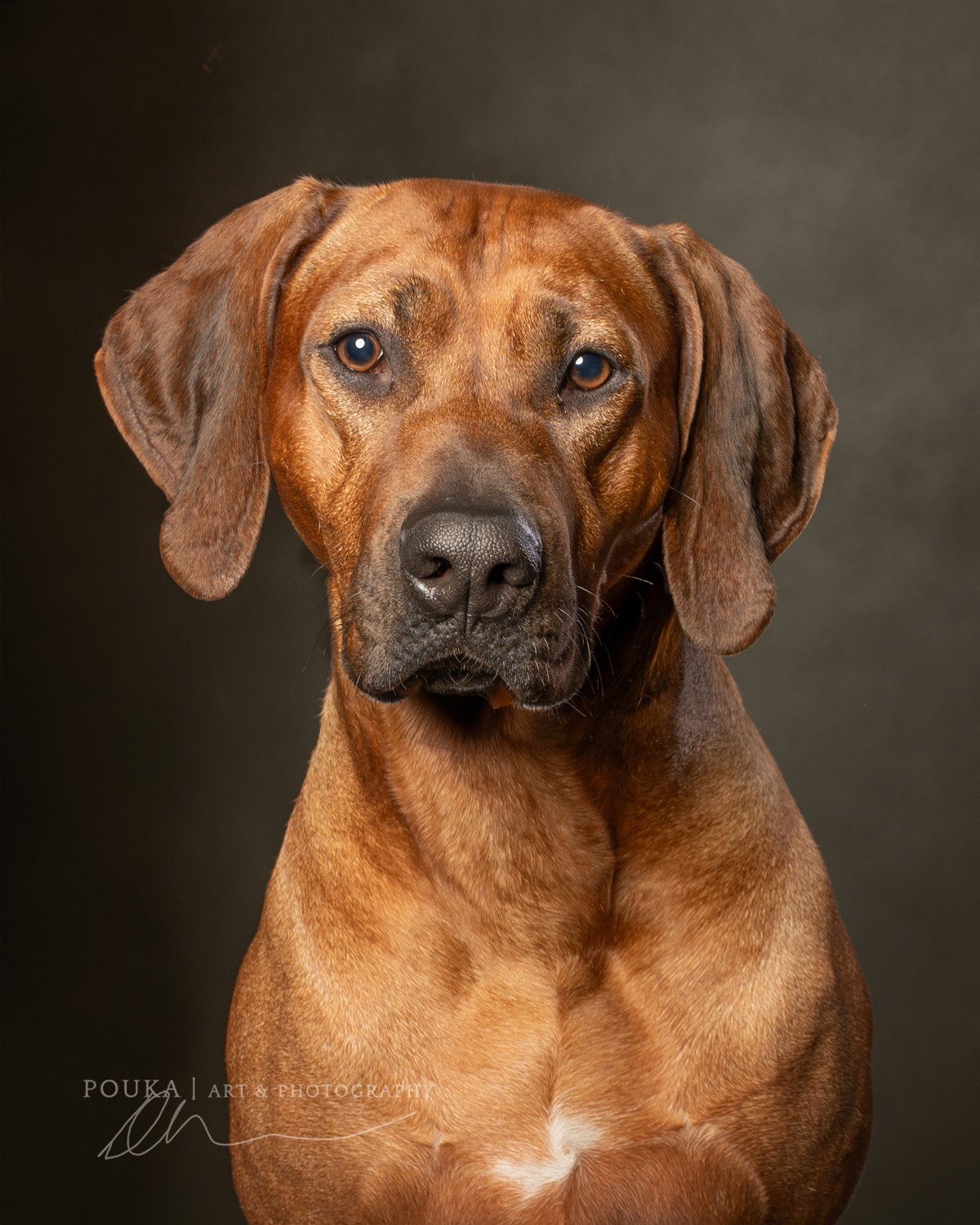
Celtic Lore’s Hammerin’ “Hank” by Wildewood